

The Nyanga are a subgroup of the Kivu peoples of Democratic Republic of Congo.
Not to be confused with Nyanga (or Manianga, Manyanga) tribe (Kongo subgroup).
Today they live predominantly in the Kivu region of the Democratic Republic of the Congo, near the frontier with Rwanda and Uganda. Their homeland is a mountainous rain forest.

The Nyanga economy revolves around hunting, trapping, and food gathering, as well as banana growing. They farm and raise cattle for milk and meat.
The Nyanga of Congo (Kinshasa) are numbering 375,000 (Peoplegroups.org, 2024)
Their national epic is the karisi Mwindo.
Historically farmers, they supplemented their diet through hunting. The Nyanga are organized into chiefdoms and possess a number of initiation societies. Their mythology is often expressed in the form of heroic songs called Karisi. The foundation of Nyanga myth lies with the Twa Pygmies of Kivu. It is acknowledged that their heroic poetry tradition came from the local Twa. Many of the deities or “Bashumbu” worshipped by not only the Nyanga but related ethnic groups such as the Hunde, Kumbure, Tembo, and Shi are of Twa origin.
The jungle was the world of the Nyanga and the village existed at the center of that world. The rainforest was a benevolent being to the Twa, but for the Bantu it was a hostile place full of malevolent beings. At the same time the jungle was seen as a place where the Nyanga could find privacy and fulfillment. Nyanga country is mountainous rainforest crisscrossed with many rivers. Villages were usually located on hilltops to further demarcate the bush-village dichotomy. People climbed the hill to one guarded entrance and descended from the single exit in order to leave.
The Twa pygmies were highly regarded by the Nyanga for their hunting skill, generosity, musical talent, and extensive knowledge of divination. As such they were afforded many privileges over other people. The Twa had many ritual responsibilities and as the original owners of the land legitimized Nyanga chiefs. As a result of their joking relationship (a phenomenon found across much of sub-saharan Africa) the Twa freely referred to all Nyanga save the chief as “Barimi” or ignorant. Since Nyanga chiefs were forbidden to hunt, the Twa were expected to hunt in his stead. In return the chiefs were expected to lavish the Twa with gifts and recognition.
A man involved in making a fish trap, another in making a large disc from which banana paste is eaten; a boy carrying a jar with water; a woman pounding dried bananas in a mortar; another woman returning in the rain with a load of wood from the forest, covering her head with a fresh banana leaf, accompanied by a child; two hunting dogs (ntoso) ready to leave for the hunt.


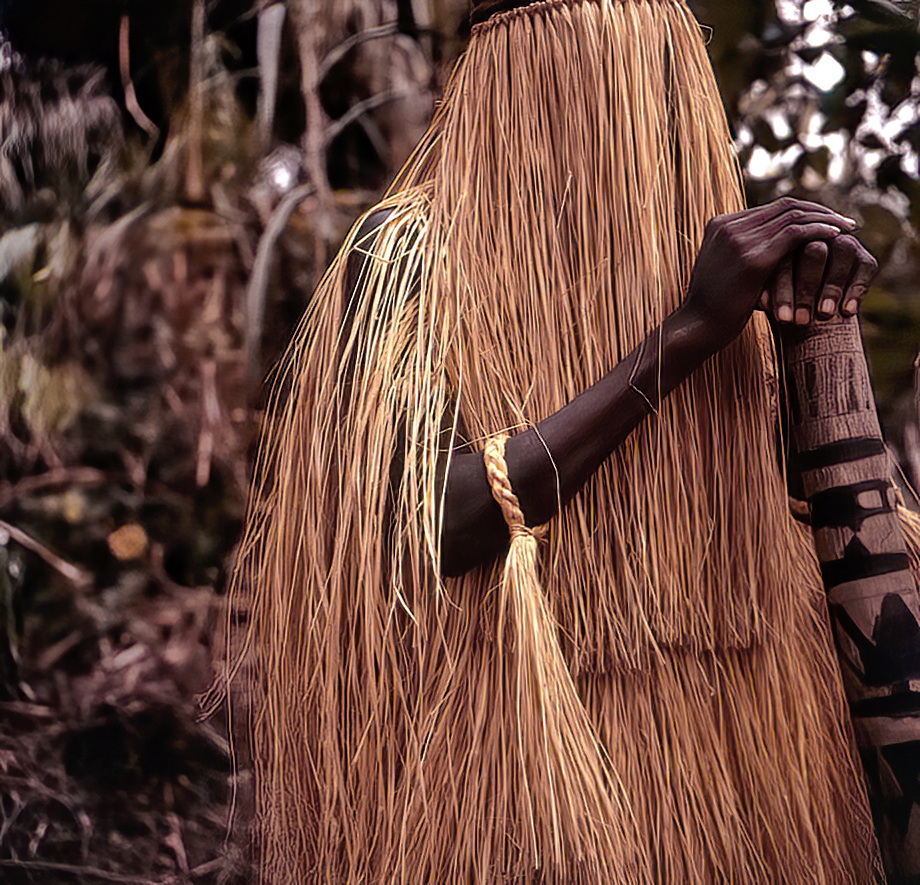
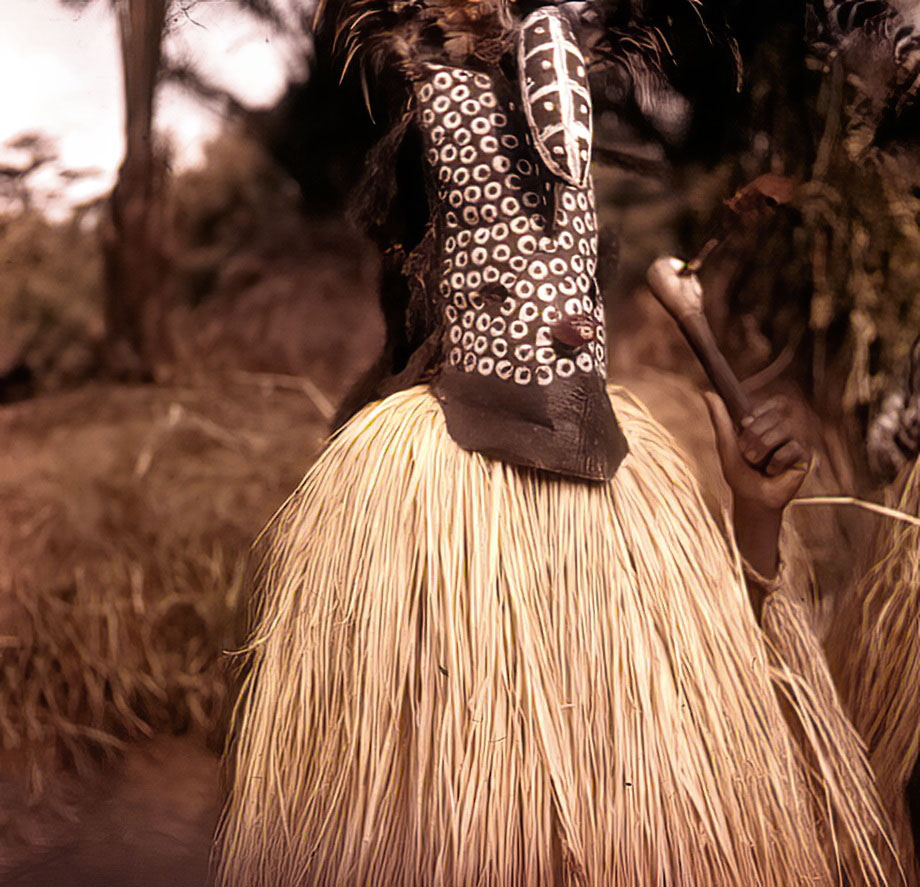
One photo shows the orchestra of four drummers, each on a different drum, flanked by singers that form the choir performing at the dances of the masked circumcisers. Three masked circumcisers are fully dressed in dance costume. One man whose face is covered with a curtain of raphia fibres representing the “father of one of the lodges (shebatende).


Three middle-aged drummers accompanying a dance for the divinity Kahombo. The drummer on the right plays the leading kioma drum. The one of the left beats the mukintsa drum with two drumsticks. The third stands holding the kandundu drum in his left arm and beats it with one drumstick. On the extreme left is seated Amato Buuni, taking notes of songs being sung by dancers.

Two young men playing an extremely primitive form of xylophone. Six elongated lightwood pieces of wood are placed on two large trunks of a banana tree. The musicians sit on opposite sides of the instrument and use two drumsticks each. Pegs are inserted into the banana tree logs to keep the six keys apart, for purposes of the resonance. The pattern of beating the keys is: one plays 6-5-4-3; the other plays 2-3-4-5.

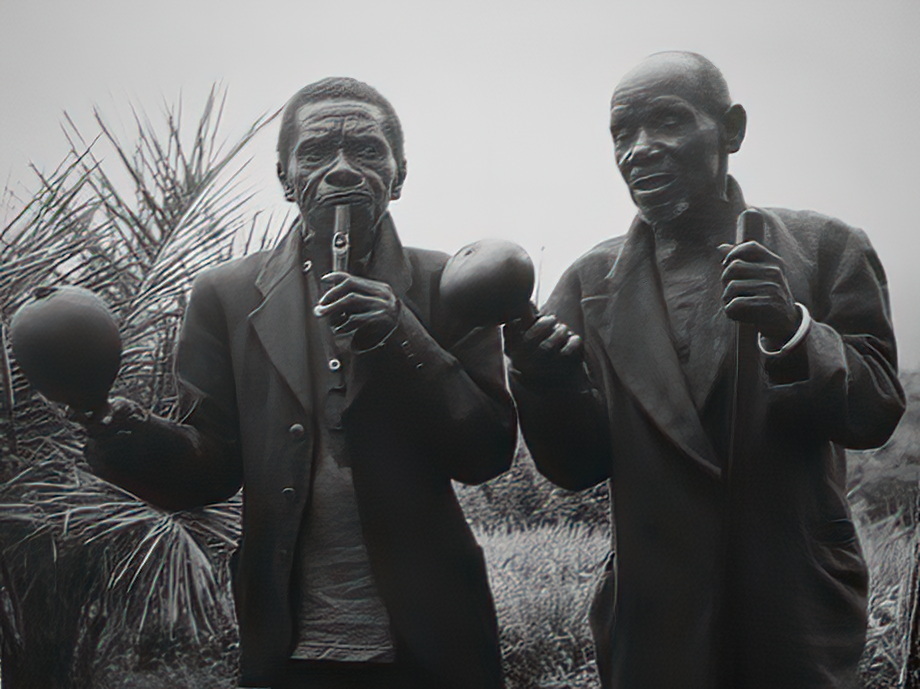
Two elders playing respectively a small flute and a calabash rattle. One has a walking stick and a calabash rattle; the flutist, who also shakes a calabash rattle, is Mr. Shembongo, famed for his flute-playing on important occasions, either alone or with the drum and rattle. Flute – imurongi reed played with 2 drums and 2 rattles for the chief.
A young man accompanying a “day dance” (bukondo) with two calabash rattles held in raised hands.

From right to left the instruments are: two-string zither (nyentse), the kioma drum played with bare hands, a dried piece taken from an old house pole rhythmically beaten with two sticks (nkwangatiro), and one man uses a calabash rattle. This kind of combination sometimes occurs when bards are singing epic tales.

Musicians, three of whom are playing the characteristic Nyanga drums: one beaten with two hands, one with hand, elbow, and drumstick; another beaten with two sticks; a fourth is beating the side of the drum with two sticks; in the back, one man is shaking two calabash rattles (ishengo). On the right in the back, a boy’s tutor is standing in his raphia costume.

Male percussionist seated on a rudimentary carved stool beating a piece of partly hollowed, dried tree root (nkwaki) with two drumsticks. He accompanies the singer of the Mubila epic, as a respondent (mwitabizia) to the epic singer. Unseen, are four other percussionists beating the larger dried house beam (nkwangatiro) and the bard.

Men, all linked with the circumcision ceremonies, executing dances that are preliminary to the actual circumcision ritual, in a small camp with “shacks” where the circumcisers dress secretly. They are in a secondary forest.

Three young men performing on the drums, apparently for a youthful “evening dance” in which young men and women participate.

A set of the three classic drums of the Nyanga: kioma, mukinsta, kandundu. Lying on top and to the back is a two-stringed zither (ntsentse). The manner in which the drums are played, the degree of tension in the membrane, and its quality are the key distinguishing factors.

An older and young Baremba Pygmy: one is playing the kantsambi (5×6, with calabash). sanza, which he holds against the calabash soundbox pressed against his stomach. Young men sing poetic songs about love, hardships, and hunting while inhabitants of the camp, men and women, young and old, dance in very tight rows.

Three Baremba pygmy musicians. The one in the center plays a kansambi type of sanza pressed against a large calabash that he holds against his stomach. The man on the left holds two, large rudimentary calabash rattles, while the one on right beats the percussion with two sticks on a dry beam (barely visible).

Demonstration of a buffalo horn blown to announce, for example, when an elephant has been killed in the forest, and men and women are called up to cut it into pieces, pack, and transport them to the village.

Two young men drumming; one holding two calabash rattles, playing for male and female “day dances.”

Young man playing the large kasayi sanza (some have up to 22 keys) that is fixed on a large calabash and that seems to be a more recent introduction to the Nyanga, probably from the Nande, north of the Nyanga.

Young man playing with two bare hands the leading drum (kioma) in an evening performance for the youth. In the background, a large men’s house (rushu) under construction.

Sources: